You can sell game currency for real money, and thousands of players do it daily despite most games banning the practice in their terms of service. The real question isn’t whether it’s possible, but whether account bans, scams, and payment disputes outweigh the potential earnings.
This guide covers the legality of selling virtual currency, which games allow or prohibit it, how to complete transactions safely, realistic earnings expectations, and the common pitfalls that catch sellers off guard.
Is it legal to sell game currency for real money?
Yes, you can sell game currency for real money in most countries. The law itself rarely prohibits exchanging virtual items for cash. Courts in South Korea, the US, and the EU have generally recognized player-to-player trades as legitimate. What gets you in trouble isn’t the law, it’s the game publisher’s rules.
Here’s the distinction that matters: you won’t face criminal charges for selling WoW gold, but Blizzard can permanently ban your account. Game companies treat real-money trading (RMT) as a violation of their terms, not as theft or fraud. They enforce inconsistently, sometimes targeting high-volume sellers while ignoring casual trades.
Regional breakdown:
- United States: No federal laws prohibit selling virtual goods. Publishers rely on contract law (ToS violations) to enforce bans.
- European Union: Similar approach—virtual item trading is legal, but publishers can terminate accounts for ToS breaches.
- Asia: Some countries, like South Korea, have recognized virtual items as having real value in court cases.
The biggest risk isn’t legal trouble. It’s losing access to your account and everything you’ve invested in it. As discussed on Law Stack Exchange, the legal grey area exists between what’s technically lawful and what violates private company policies.
Which games allow selling currency for real money?
A handful of games officially support or tolerate real-money trading, though they’re rare exceptions.
Games that allow RMT:
EVE Online pioneered legitimate RMT through its PLEX system. Players buy game time with in-game currency and sell it to other players through sanctioned channels. CCP Games recognized that players would trade currency anyway, so they built a marketplace that keeps transactions safe.
Second Life has always embraced real-money exchange. The game’s economy runs on Linden Dollars, which convert directly to USD through official channels. Some players have built actual businesses inside the game.
Roblox recently expanded its policy to let certain developers sell games and items for real dollars instead of just Robux. According to CNBC, this only applies to verified developers meeting specific criteria, but it marks a shift toward legitimizing creator earnings.
Games that ban RMT:
Most popular games prohibit currency sales completely:
- World of Warcraft
- Path of Exile
- Fortnite
- Final Fantasy XIV
- League of Legends
- Destiny 2
- Old School RuneScape (officially, though it happens constantly)
Publishers actively monitor trades and issue bans when they catch you. Some games crack down hard on first offenses, while others only act on repeat violations or large-scale operations.
How to sell game currency safely: step-by-step
Despite publishers’ efforts to stop it, real-money trading happens in virtually every popular online game. Thousands of players sell currency daily because the demand exists, and the enforcement, while real, is inconsistent.
The question isn’t whether you can sell. It’s whether you can sell without immediately getting caught. The answer depends entirely on how you do it.
What separates sellers who get banned in weeks from those who operate for months:
The difference comes down to detection patterns. Publishers can’t manually review every trade, so they rely on automated flags that catch obvious behavior:
High-risk (gets you banned):
- Trading massive amounts in single transactions (50M+ gold)
- Meeting the same buyer repeatedly in the same location
- Using in-game mail to send gold to the same recipients
- Advertising in-game or on official forums
Lower-risk (harder to detect):
- Moderate transaction sizes spread over time
- Face-to-face trades in populated areas (looks like normal player trading)
- Different buyers, different amounts, different timing
- Using third-party marketplaces that verify buyers
No method is 100% safe, but understanding what triggers automated systems lets you minimize risk. Here’s how to structure your transactions to stay under the radar.
Choose a marketplace with escrow protection
Platforms hold buyer payments until you complete delivery, which prevents the “I’ll pay you after” scam common on Discord or Reddit. The platform verifies the buyer received their gold before releasing funds to you.
You’ll pay fees (typically 5-15%), but you eliminate the most common fraud scenarios. Eldorado’s escrow system protects both buyers and sellers throughout the entire transaction.
Direct trades through Discord servers or Facebook groups skip fees but leave you completely unprotected. If a buyer claims they never received the gold, you have zero recourse.
Verify buyer accounts before trading
Check buyer feedback ratings, account age, and transaction history before accepting offers. New accounts with no history are red flags. Buyers using stolen payment methods will complete the trade, then the real cardholder disputes the charge weeks later, leaving you without the gold or the money.
Select safe payment methods
PayPal disputes favor buyers heavily, making it risky for sellers. Cryptocurrency payments offer more protection since they can’t be reversed, though they add complexity and fees. Skrill and other e-wallets provide middle-ground options.
Most marketplaces handle payments for you, removing the need to manage payment processors directly.
Use official in-game trade systems
Face-to-face trades in-game create transaction logs that prove delivery. Mailing gold or dropping items in obscure locations looks suspicious to automated monitoring systems and increases ban risk.
Never give buyers your account login credentials “for faster delivery.” That’s always a scam attempt to steal your account.
Document everything
Screenshot trade windows, chat logs, and delivery confirmations. If a dispute arises, evidence proves you completed your end of the deal. Most marketplaces require proof of delivery to release escrowed funds.
How much can you make selling game currency?
Earnings depend entirely on which game you’re farming and how efficiently you generate currency. Gold values fluctuate based on game economy inflation, new content releases, and seasonal player population changes.
Old School RuneScape gold sells for roughly $0.17-0.50 per million. A skilled player farming Vorkath or running the Corrupted Gauntlet can generate 3-5 million gold per hour, translating to $1.20-3.00 hourly. That’s below minimum wage in most developed countries.
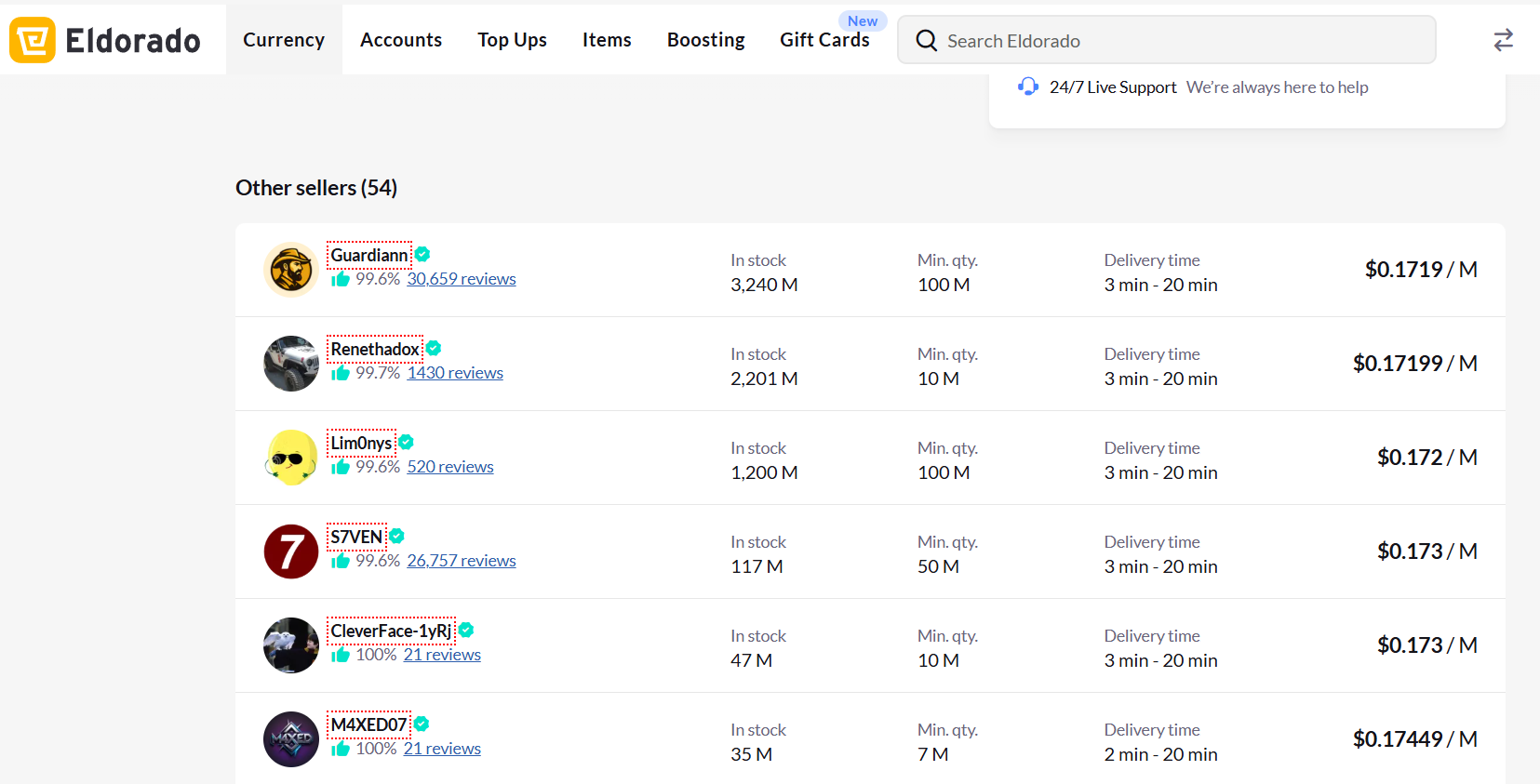
World of Warcraft gold rates hover around $34.15-34.76 per 1 million gold, depending on server and faction. Efficient farmers might earn $5-10 per hour, though Blizzard actively bans accounts caught RMT trading.
Path of Exile currency prices peak at league starts when demand surges. Common currencies like Chaos Orbs sell for $0.07-0.10 per unit during early league, but prices typically drop 20-40% within 2-3 weeks as supply increases and more players reach endgame.
The reality check: RMT rarely generates a livable income unless you’re running large-scale operations with multiple accounts, which multiplies ban risk exponentially. Most individual sellers make supplemental cash at best, not replacement income.
Pro tips: how to avoid scams and stay safe
Red flags to watch for:
- Buyers offering above-market rates “for fast delivery”
- Requests to trade outside the platform where you connected
- Asking for your account login or email access
- Brand new accounts with no transaction history
- Buyers who won’t use escrow or insist on “friends and family” PayPal payments
- Pressure to complete trades quickly before “the offer expires”
Protection strategies:
- Enable two-factor authentication (2FA) on all gaming and payment accounts
- Complete KYC verification on marketplaces to access dispute protection
- Check buyer reviews and transaction history before accepting offers
- Never share login credentials under any circumstances
- Use platforms with built-in dispute resolution
- Join Reddit communities like r/GameTrade to learn about current scam tactics
The Discord/Reddit scam works like this: someone posts a great offer on a trading subreddit, you DM them, they send a fake payment screenshot, you deliver the gold, and they vanish. Always verify that payments hit your account before delivering anything.
Where to start: trusted marketplaces for game currency
Your main options split between dedicated marketplaces and direct peer-to-peer trades. Each comes with different tradeoffs between safety and fees.
Dedicated marketplaces provide escrow services, buyer verification, and dispute resolution. They charge fees (typically 5-15% of transaction value) but handle the trust problem. You list your currency, buyers purchase it, the platform holds payment until delivery confirmation, then releases funds to you.
Eldorado.gg offers a secure marketplace with TradeShield protection, making it safer for both new and experienced sellers. The platform handles payment processing, dispute resolution, and buyer verification so you can focus on delivery.